
Rockfall and rock slidesFlagship project

City of Kufstein – Sensor-based monitoring at Kufstein Fortress

Historic masonry, rock in hard-to-reach areas and large numbers of visitors: at Kufstein Fortress, a self-powered multi-sensor system continuously records micro-movement and vibration – so that changes become visible before they turn into a risk.

Kufstein Fortress with sensors on the historic wall
© GMD® GmbH

Together with the City of Kufstein and the State of Tyrol, GMD® has set up permanent, self-powered monitoring of masonry and rock at Kufstein Fortress as part of a flagship project.

Instead of assessing conditions only during periodic inspections, the sensors deliver data around the clock – including at points that are difficult to access.

Location: Kufstein Fortress, Tyrol (AT) · Partners: City of Kufstein, State of Tyrol · Installation: April 2024

Project key figures

Sensors
20
Installation
April 2024
Power supply
self-sufficient
Operation
year-round
Measurement interval
[Placeholder: interval]
Historic masonry and rock at Kufstein Fortress
© GMD® GmbH
Chapter 1

Background: masonry, rock and visitor operations

Kufstein Fortress towers on a rock above the town and is one of Tyrol's most popular visitor attractions. Here, centuries-old masonry stands directly on and next to rock that is exposed to weather, freeze-thaw cycles and vibration.

This results in three requirements that make each other harder to meet:

  • Hard-to-reach areas: parts of the wall and rock can only be inspected using rope access or an aerial work platform.
  • Heritage protection requirements: interventions in the historic fabric must be kept to the absolute minimum.
  • Visitor operations: paths, squares and viewpoints below the walls are in constant use.

Conventional structural inspections only provide snapshots. What happens between two inspections remains invisible.

Chapter 2

Why continuous monitoring instead of snapshots

Damage to masonry and rock rarely develops suddenly. It is usually preceded by small movements that grow over weeks and months – cracks opening, changes in inclination, an altered response to vibration.

Such trends can only be identified through continuous measurement. Only the time series shows whether a movement fluctuates seasonally and reverses, or whether it continues.

Micro-movement
The smallest changes in position of masonry and rock become visible as a trend.
Vibration
Seismic sensors and acceleration measurement record oscillations and individual events.
Environmental conditions
Temperature and weather are measured as well, to separate seasonal effects from genuine changes.
Chapter 3

The system architecture at a glance

A self-powered multi-sensor system combining seismic sensors, acceleration measurement and edge IoT – without a power connection and without cables through the masonry.

  1. Layer 1

    Data capture

    20 sensors on masonry and rock continuously measure movement, vibration and environmental parameters.

  2. Layer 2

    Edge processing

    The measurement data is pre-processed directly in the sensor node – saving energy and airtime.

  3. Layer 3

    Transmission

    The sensors send their data by radio to the GMD® platform – without any cabling in the structure.

  4. Layer 4

    Analysis

    GeoSenseAI® displays time series, compares measuring points and reports deviations based on defined thresholds.

Redundancy instead of single readings: the assessment is based on the interplay of several sensors and parameters, not on a single value.

Chapter 4

Installation under heritage protection

On a listed structure, the installation itself is part of the solution. The sensor system was designed to require only minimal intervention:

  • Self-powered: no power lines, no cable routes across walls and rock.
  • Compact sensor nodes: unobtrusive within the appearance of the fortress.
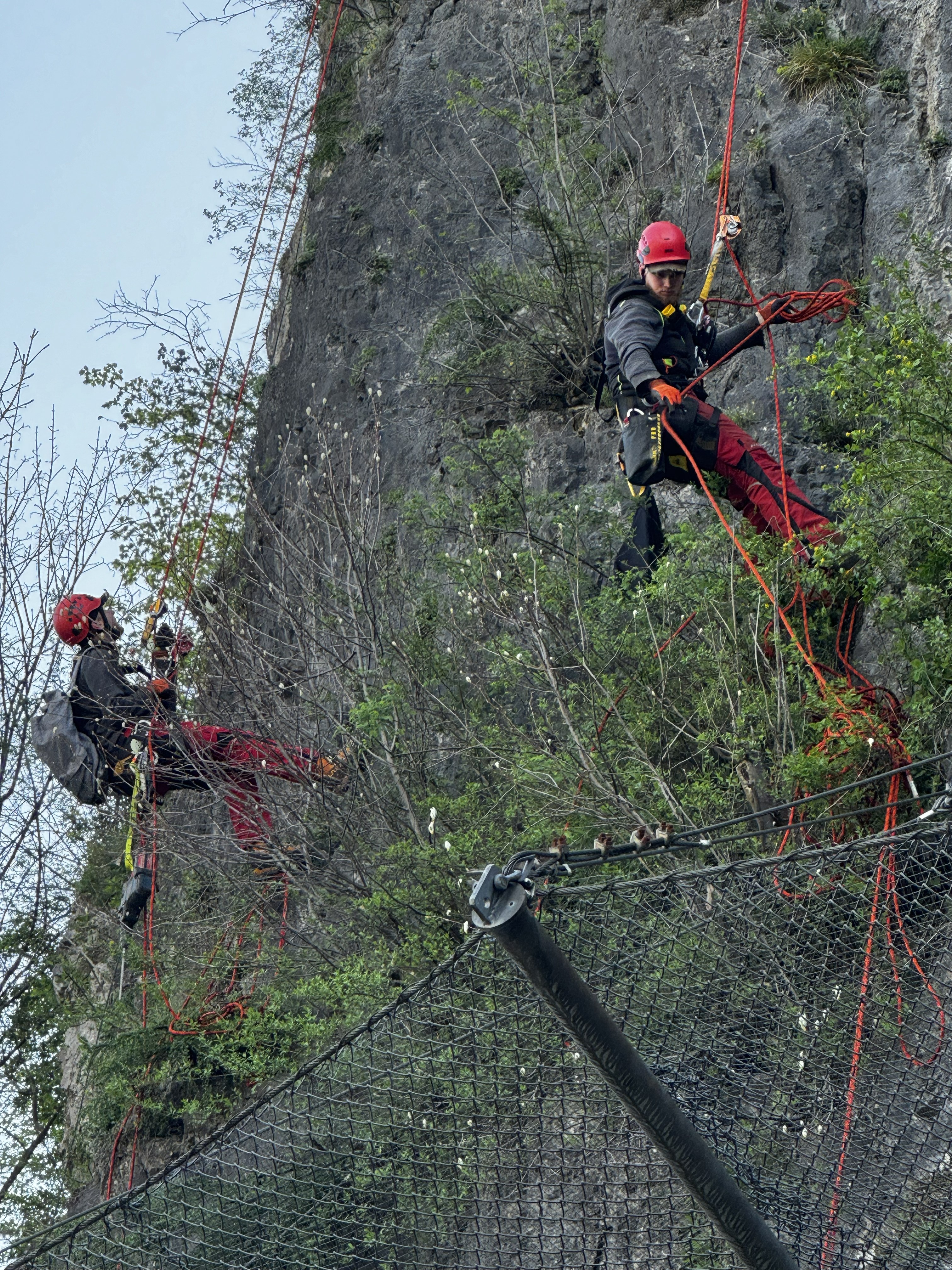
  • Installation by the GMD® team: including in areas with a risk of falling, coordinated with the responsible authorities.

Measuring without changing the structure you want to protect.

Especially with historic fabric, this is the precondition for being allowed to operate monitoring on a permanent basis at all.

Chapter 5

Outcome: detect early, act in a targeted way

  1. Ongoing

    Early detection

    Changes to the wall and rock become visible long before they can be seen with the naked eye.

  2. When anomalies occur

    Targeted maintenance

    Inspections and repairs can be deployed where the data suggests – rather than at rigid intervals.

  3. Long term

    Traceable documentation

    The time series provide a reliable basis for decisions by the owner, heritage conservation and those responsible for safety.

GMD® systems provide measurement data and a basis for decisions. They do not replace professional assessment by experts and the competent authorities.

From flagship project to standard solution

Kufstein Fortress was an early stress test for GMD®: vibration and movement measurement at a site where structure, rock and visitor operations meet. The experience gained in installation, power supply and data transmission has fed into the further development of GMD® sensor technology.

The concept can be transferred to castles, ruins and town walls, to retaining walls and rock slopes along transport routes, and to protective structures in rockfall zones.

We would like to thank the City of Kufstein and the State of Tyrol for their trust and for the opportunity to deploy our system at one of Tyrol's best-known landmarks.

Need to monitor masonry, rock or protective structures?

We'll show you how the Kufstein Fortress concept can be applied to your structure or site.