
Water resourcesMountain hut

German Alpine Club – Self-powered water monitoring at Neue Prager Hütte

At 2,796 m in the Hohe Tauern National Park, there is neither a power grid nor mobile coverage. Even so, a self-powered sensor system delivers data on spring discharge, tank levels and weather every minute – as the basis for climate-adapted water management at the hut.

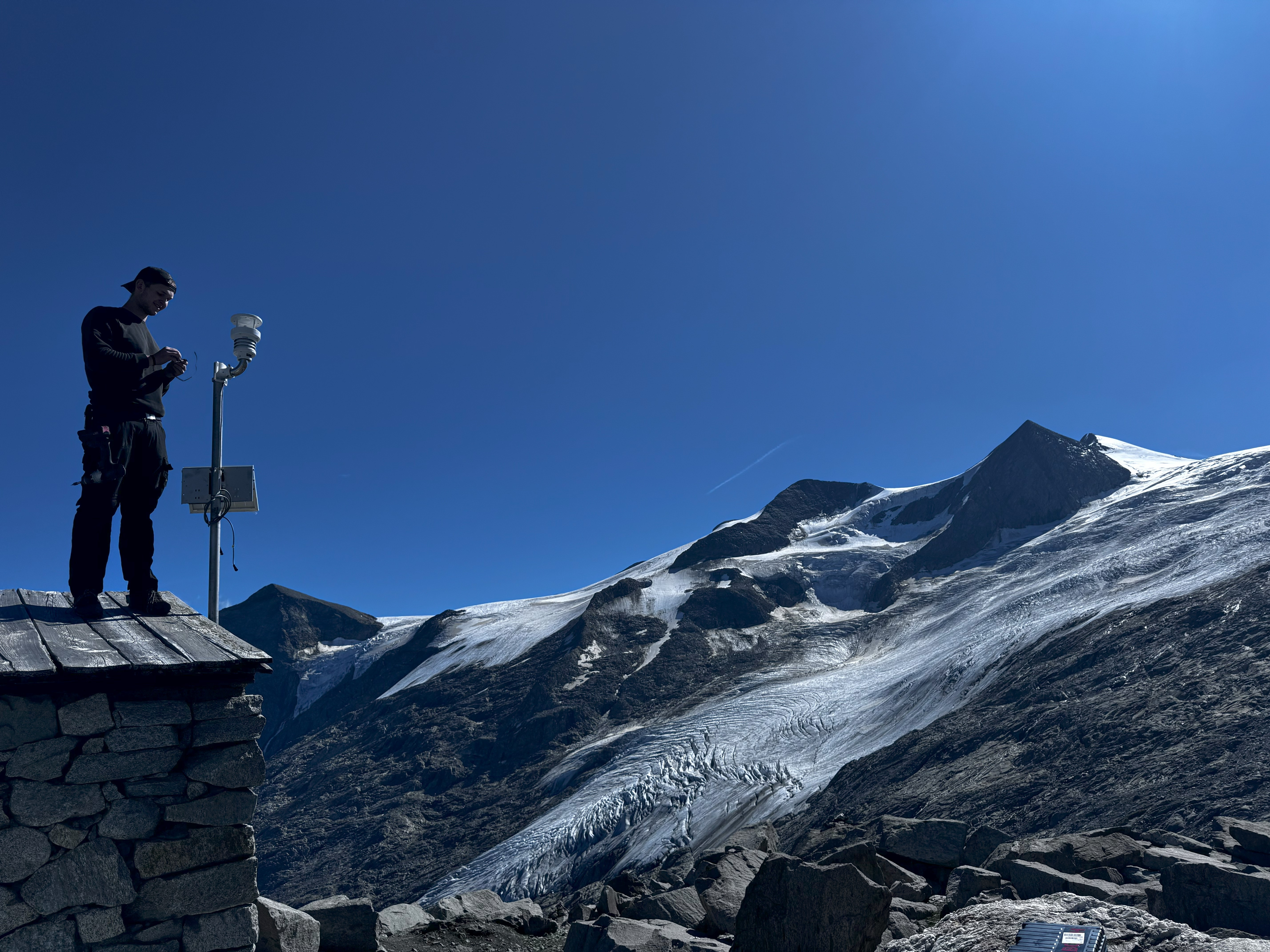
Neue Prager Hütte in the high mountains with measuring station
© GMD® GmbH

For the German Alpine Club, GMD® has set up self-powered water resource and environmental monitoring at Neue Prager Hütte – from the sensor at the spring intake to the analysis in GeoSenseAI®.

The hut team and the DAV can see at any time how much water is flowing in, how full the tanks are and how precipitation and weather are developing.

Location: Neue Prager Hütte, Hohe Tauern National Park, Tyrol (AT) · Partner: German Alpine Club (Deutscher Alpenverein e. V., DAV)

Project key figures

Altitude
2,796 m
Measurement areas
4
Data delivery
every minute
Mobile network / satellite
LoRa
Power supply
solar, self-sufficient
Neue Prager Hütte with measuring station in the foreground
© GMD® GmbH
Chapter 1

Background: water as a scarce resource in the high mountains

Neue Prager Hütte sits high above the valley at the foot of the Großvenediger. Its drinking water comes from springs whose discharge varies strongly with snowmelt, precipitation and temperature. Climate change is amplifying these fluctuations: dry spells are getting longer and the snowmelt is starting earlier.

For hut operations, this raises a recurring question: will the water last for the next few days – and when do we need to start saving?

Until now, the only way to answer this question was to go and check on site. Power and data infrastructure for automatic measurement is completely absent at the spring intake.

Chapter 2

The measurement concept: the entire water chain in view

Measurements are taken not at a single point but along the route from inflow to storage – supplemented by the weather data that drives the inflow.

Spring discharge
How much water is the spring delivering right now – and how does the discharge change over days and weeks?
Tank at the spring intake
Level measurement in the collection tank directly at the spring.
Header tank
Level of the storage tank that supplies the hut.
Weather station
Precipitation and other environmental factors – the cause of changes in discharge.
Chapter 3

Measuring without power and without a mobile network

There is no permanent power connection at the spring intake. GMD® therefore developed its own solar-powered sensor that samples the level in the aluminium tank to the second – all year round and independently of pumps or cables.

At this altitude, there is no reliable infrastructure for data transmission either. A purpose-built IoT architecture transmits the readings to the data centre every minute – without a mobile or satellite connection.

No network, no power, almost 2,800 m above sea level – and still data every minute.

It is precisely these conditions that make the project a stress test for sensor technology, power supply and radio transmission in the high mountains.

Chapter 4

The system architecture at a glance

  1. Layer 1

    Data capture

    Solar-powered sensors measure spring discharge, tank levels and weather data directly on site.

  2. Layer 2

    Transmission

    A dedicated radio architecture forwards the data every minute without mobile network or satellite.

  3. Layer 3

    Platform

    GeoSenseAI® stores the time series, presents them graphically and makes trends visible.

  4. Layer 4

    Use

    The DAV and the hut team see the current water status and can plan operations ahead.

Chapter 5

Benefits for hut operations and the Alpine Club

  1. Daily

    Real-time overview

    Inflow and tank levels can be checked at any time – without walking to the spring intake.

  2. Seasonal

    Better planning

    Shortages become apparent early, so water-saving measures and supply can be planned in good time.

  3. Long term

    Climate adaptation

    The time series show how the spring changes over the years – a basis for investment decisions.

One system design for many mountain huts

Many mountain huts in the Alps face the same question: how will their own water supply develop as summers become drier and snow cover thinner?

The system design developed at Neue Prager Hütte is built to be transferred cost-effectively to other huts – with the same self-powered sensors, the same radio architecture and the same platform.

Beyond mountain huts, the concept is suitable for spring intakes and elevated reservoirs operated by municipalities, alpine pastures and cable car companies, as well as for the water supply of remote tourist facilities.

Need to monitor a spring or a hut?

We'll show you how the Neue Prager Hütte concept can be applied to your water supply.